4th of July Baby Outfits That Don't Look Like a Costume
Festive enough for the photo. Comfortable enough for the whole day. Wearable in August.
The problem with most 4th of July baby outfits is not the patriotism. It is the single occasion they were designed for.
A baby in a flag onesie is fine for the photo. It is less fine at hour three of a backyard cookout in ninety-degree heat, in a garment that feels like a craft project held together by iron-on letters. The baby is hot. The novelty has passed. The outfit has done its one job and is now just clothing — itchy clothing, at that.
This is a guide about the other version. The 4th of July baby outfit that is festive enough for the photo, comfortable enough for the full day, and wearable enough that it makes sense in August without an explanation.
Soft, Breathable, Lightly Patriotic, Wearable Again.
A 4th of July baby outfit that works tends to share a few qualities: soft natural cotton, a restrained palette that references the holiday without announcing it, and a design interesting enough to photograph without being loud enough to overshadow the baby wearing it.
The test is simple: could you put it on a Tuesday in mid-July and have it make sense? If yes, it was designed as clothing. If it only works on one specific national holiday, it was designed as a prop.
The difference is usually visible in the garment itself. Props have novelty graphics. Props use polyester. Props come with a giant bow that costs more than the outfit. Clothing — real summer clothing that happens to be festive — does not need the holiday to justify its existence.
Most 4th of July Baby Outfits Are Optimized for the Purchase, Not the Day.
The category has a structural problem: the incentive to buy and the incentive to wear are not the same thing. A 4th of July baby outfit that earns a reaction in a screenshot has already done most of what it was designed to do. The actual day — seven hours of BBQ, heat, and an attempted nap — is secondary.
The flag costume. The most common version. A red, white, and blue outfit that does not leave room for interpretation — the graphic makes clear that this baby is dressed for July 4th specifically. It photographs fine. It also tends to be unwearable on any other day of the year, and usually made of fabric that communicates this to the baby within twenty minutes.
The novelty caption. “My First 4th of July” in stars and stripes. A baby eagle with a flag. Fireworks across the chest. These are not outfit choices — they are captions. The graphic explains the date so thoroughly that the outfit has nowhere else to go after the explanation.
Oversized accessories. The giant star headband. The bow wider than the baby’s face. The accessory that is removed in the first thirty seconds after the photo. These exist primarily for the photo. They do not survive the day.
The wrong fabric in the wrong month. The purest red, the crispest white, the truest navy — these are also the colors that feel worst in July heat, especially in cheap polyester. Primary patriotic is hard to pull off in natural fabric tones. It is easier to pull off in synthetic, which is unfortunate, because July is hot.
One-wear design. Any outfit that requires July 4th to make sense will only be worn on July 4th. One wear. Then a drawer until next year, when the baby has outgrown it.
The Better Version References Summer, Not Just the Holiday.
The best 4th of July baby outfits share an approach: they are summer outfits first. The patriotic reference — if there is one — is in the palette or a single detail, not in a graphic that announces the occasion.
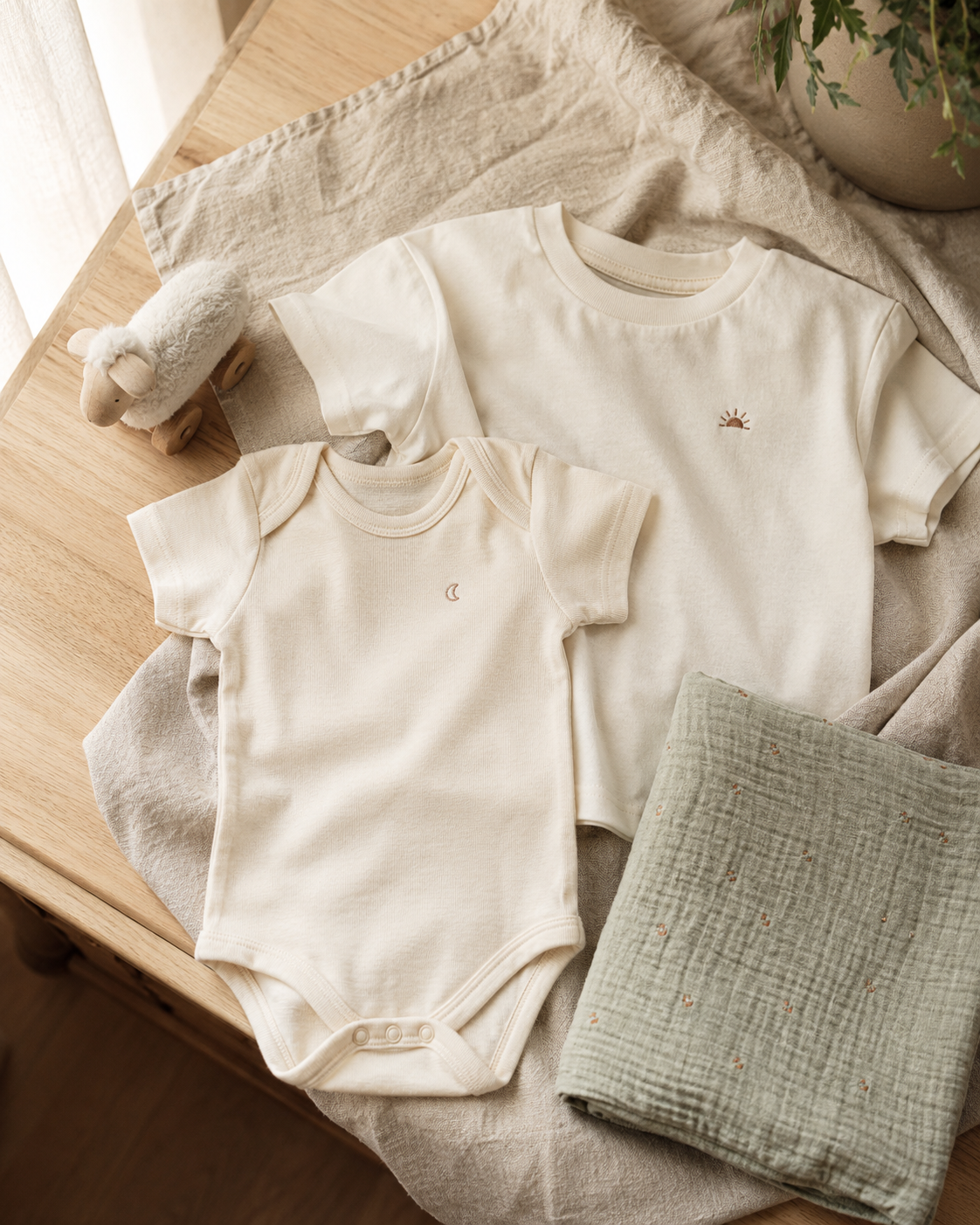
A soft, clean bodysuit in natural or cream fabric. A baby in a cream cotton bodysuit with a small summer detail photographs as well as a baby in a full stars-and-stripes ensemble, without the discomfort. The photo reads as intentional. The fabric reads as quality. The baby is cooler.
A color reference, not a costume. A red bodysuit. A white romper with a subtle graphic. A navy-and-white stripe that reads as nautical before it reads as patriotic. These reference the palette without costuming the baby.
A design that works on its own terms. A watermelon. An ice cream. A smiling sun. A popsicle with a star detail. These are summer images that happen to work for a July cookout. They do not need the holiday for context, and they are still accurate in mid-August.
Comfortable cut and weight. Short sleeves. Loose enough to move. A bodysuit or one-piece that gives the baby room. The outfit choice for a parade at 11 a.m. in July is also a heat-management decision, and fabric wins over graphic every time.
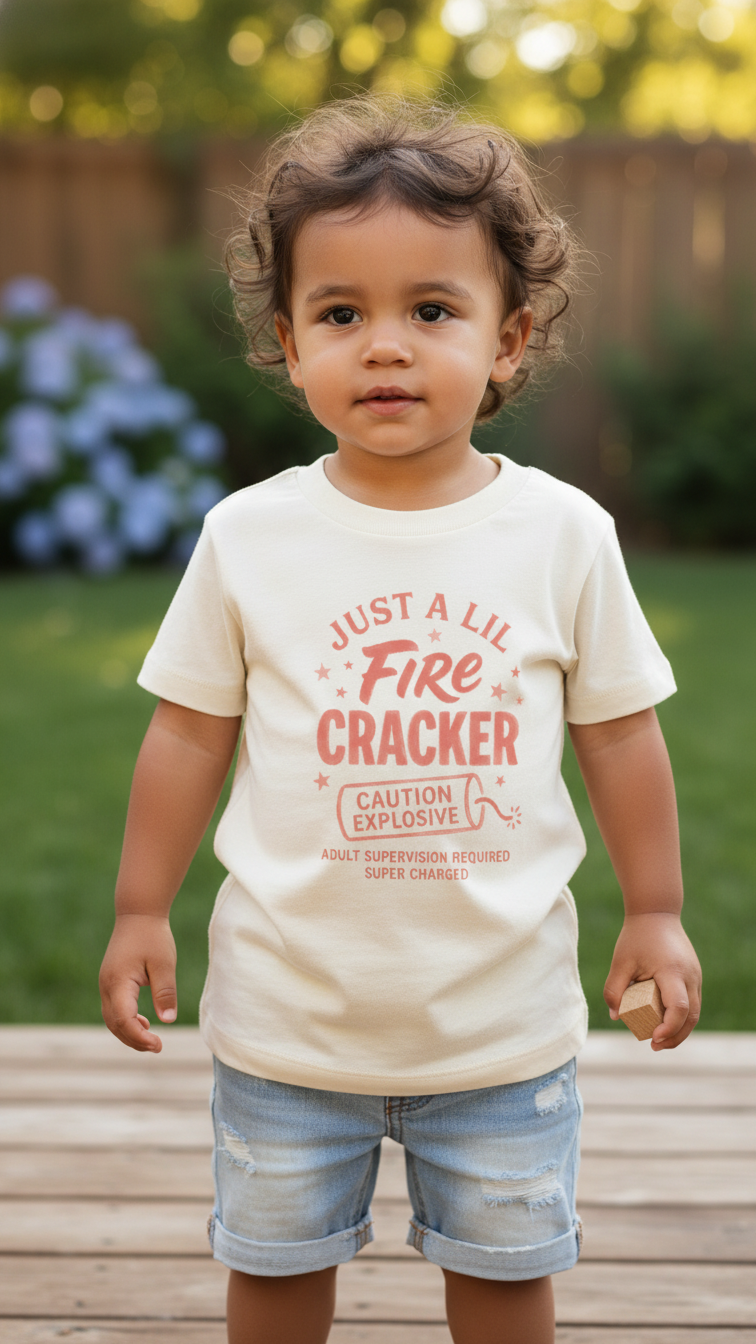
“A good 4th of July baby outfit should read as summer first. The holiday is context, not the whole story.”
Red, White, and Blue Works — When It Is a Palette, Not a Uniform.
The patriotic color combination is not the problem. The ratio is.
When red, white, and blue appear on a garment in roughly equal measure, the outfit reads as a patriotic uniform. The flag association is immediate. The costume register follows. This is not a problem if the goal is a costume. It is a problem if the goal is a baby outfit that also happens to be festive.
The more useful approach: one base, one accent.
A cream or natural bodysuit is the base. A small red or navy detail — a subtle graphic, a stripe at the collar, a single element — is the accent. The eye reads “summer” before it reads “patriotic,” which is the correct order for clothing that is supposed to outlast the holiday.
Navy reads differently than red. A soft navy in natural cotton is a clothing choice. The same shade in a synthetic sheen reads as costume. Material changes the register of color faster than the color itself.
Soft primary, not hard primary. Vintage red. Faded blue. Dusty navy. These are patriotic without being primary. They sit in photographs the way real summer clothing sits in photographs — present without dominating.
One patriotic color per outfit. A cream bodysuit with a red graphic. A white romper with a blue detail. A natural onesie with a star. These read as coordinated, not costumed.
It Is July. The Material Is the Decision.
The 4th of July is in the middle of summer. In most of the country, it is hot. This is relevant to the clothing decision in a way that is often underweighted when the purchase is made three months ahead, optimized for the photo rather than the actual day in actual heat.
Cotton, not polyester. The easiest rule. Natural cotton breathes. Polyester does not. A baby in a polyester flag onesie in July is a baby in a heat-trapping layer in a month that does not require one. Natural cotton stays cooler, feels better against skin, and washes without becoming scratchy.
Lightweight over structured. A thin-weight bodysuit in natural fabric is the foundation of a summer outfit. If the baby needs a layer for evening fireworks in a cooler climate, that is a separate garment — a light cotton sweatshirt, a thin cardigan — layered over the day’s base. Not a single heavy piece trying to do everything.
Short sleeves in the daytime. Not sleeveless (sun exposure), not long sleeves (too warm for a noon parade). Short sleeves at a backyard BBQ are the practical choice for a baby who cannot regulate their own temperature. For evening events, a light layer over the day’s base.
Fit that does not bind. A bodysuit that does not restrict at the legs or arms. A romper with room to be placed down, picked up, and moved around a lawn for several hours. Babies do not want to be held in their clothing on a hot day.
The fabric decision is the most important decision in a summer baby outfit. The graphic comes second. The patriotic detail comes after that. The material is what the baby is actually wearing for the whole day.
What to Wear, Based on Where the Day Actually Goes.
The 4th of July is rarely one setting. It is usually several — morning, midday, and evening — and each requires something slightly different from an outfit that ideally does not require a full change.
Backyard BBQ. The longest context. Most of the day. Priority is comfort. A soft cotton bodysuit or lightweight romper, loose fit, breathable. The festive detail here should be in the fabric tone or a small graphic — not in maximum patriotic expression. This is the outfit the baby actually wears for five hours. Design for that.
Parade or town event. Usually the most photographed moment of the day. One patriotic color reference, a design that reads as festive from a few feet away, still natural fabric, still practical. The parade happens and the photos happen, then the baby goes back to the BBQ. The outfit should handle both settings without needing to be changed between them.
Lake or pool day. Swimwear is the primary layer. A good UPF swimsuit, a sun hat that will stay on for the first fifteen minutes, a cotton coverup for shade. The festive element here is in the palette — a stripe, a subtle color — not in a heavy graphic on swimwear. Practical and sun-safe is the main job. The holiday is the occasion, not the design brief.
Family photos. The one moment where coordination is worth planning. A soft palette across the family — cream, natural, one accent color — photographs better than identical patriotic costumes. The baby does not need to be the loudest piece in the frame. A quiet, well-made base garment against a slightly more put-together adult look often photographs better than the reverse.
For the full coordination logic across the family, matching family outfits that don’t look cheesy covers this territory in more depth.
Evening fireworks. At some point, probably before the fireworks end, the baby will be asleep or trying very hard to be. A comfortable, slightly warmer layer for the cooling evening temperature: a light sweatshirt or thin fleece over the day’s base layer. The patriotic statement of the day has already been made. This outfit is for survival and transit.
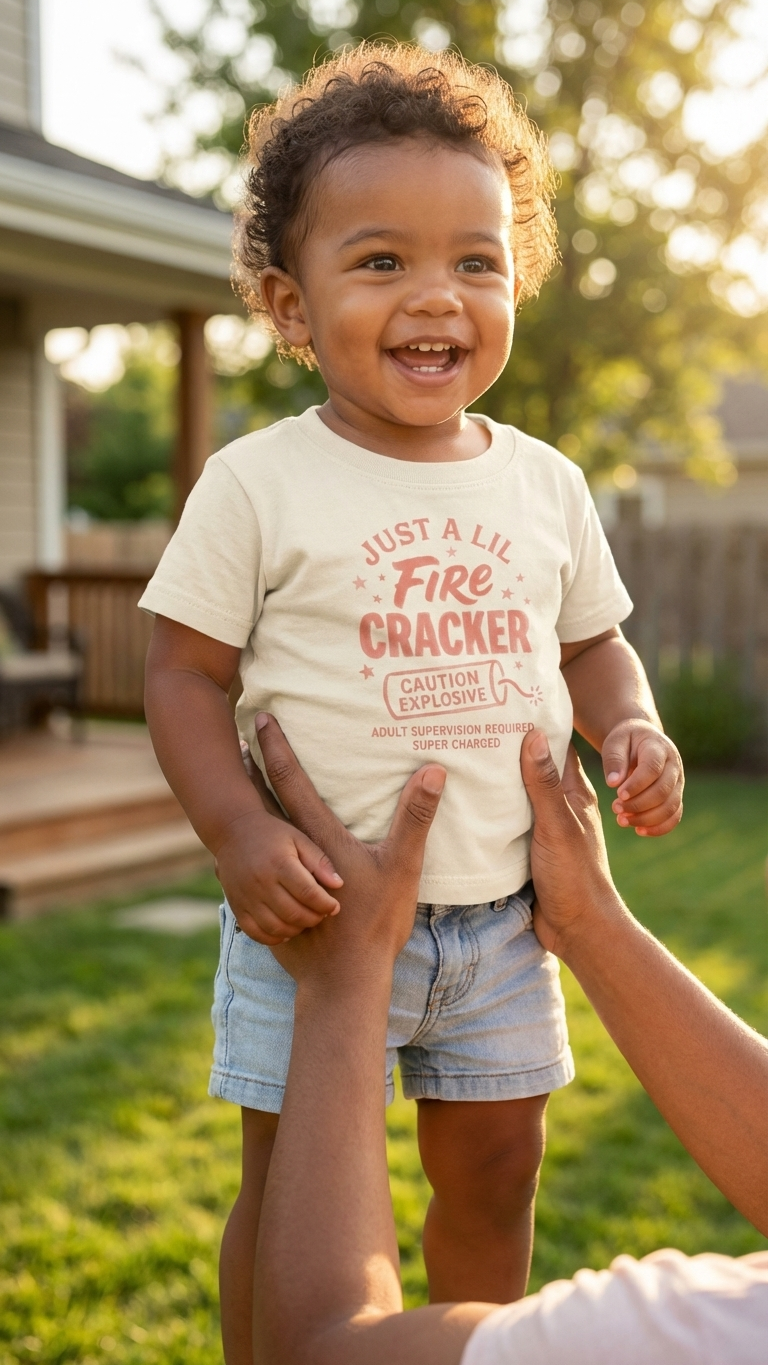
“The photo is one moment of the day. The outfit is the whole day.”
Design the outfit for the day. The photo will take care of itself.
A Short List.
The flag costume. If someone else’s first read is “the baby is dressed as a flag,” the outfit has done too much work and left nothing for the baby or the day.
Giant novelty accessories. A star bow wider than the baby’s face exists for the photo. The photo will often look better without it.
Polyester in July. Shiny. Stiff. Hot. Polyester prints well in bold primary colors, which is why it shows up in this category. It is not a good experience for a baby wearing it in ninety-degree weather.
Caption outfits. “My First 4th of July” in three fonts. The graphic explains the date so thoroughly that there is no room for anything else — not the baby, not the day, not the actual setting. These are also frequently outgrown before July 4th of the following year.
Matching family costumes — as distinct from coordinated family looks. A family in identical flag outfits will photograph as a costume in a way that coordinated summer clothing will not. The difference between a family that looks like they belong together and a family that dressed up for a national holiday is mostly in whether the clothes were designed as clothing. Both are valid choices. They read differently.
Anything the baby cannot sleep in. Sequined stars. Stiff iron-on graphics. A novelty element that requires the baby to stay upright. At some point, the baby will sleep. Plan for that.
Festive Without the Costume Energy.
The “Patriotic Popsicle” design is a reasonable illustration of the premise of this article. The graphic is a starry ice cream — popsicle imagery with a star detail — which reads as a summer treat before it reads as a patriotic statement. It is festive in the way that a backyard cookout is festive: casually, without announcing itself.
It works on the 4th of July. It also works on the 14th of July, when the holiday is over and the baby still needs something to wear to the park.
That is the version worth buying: the outfit that is clear about what it is (a summer garment), has an optional patriotic reference (the stars), and does not need a specific date to justify its existence.
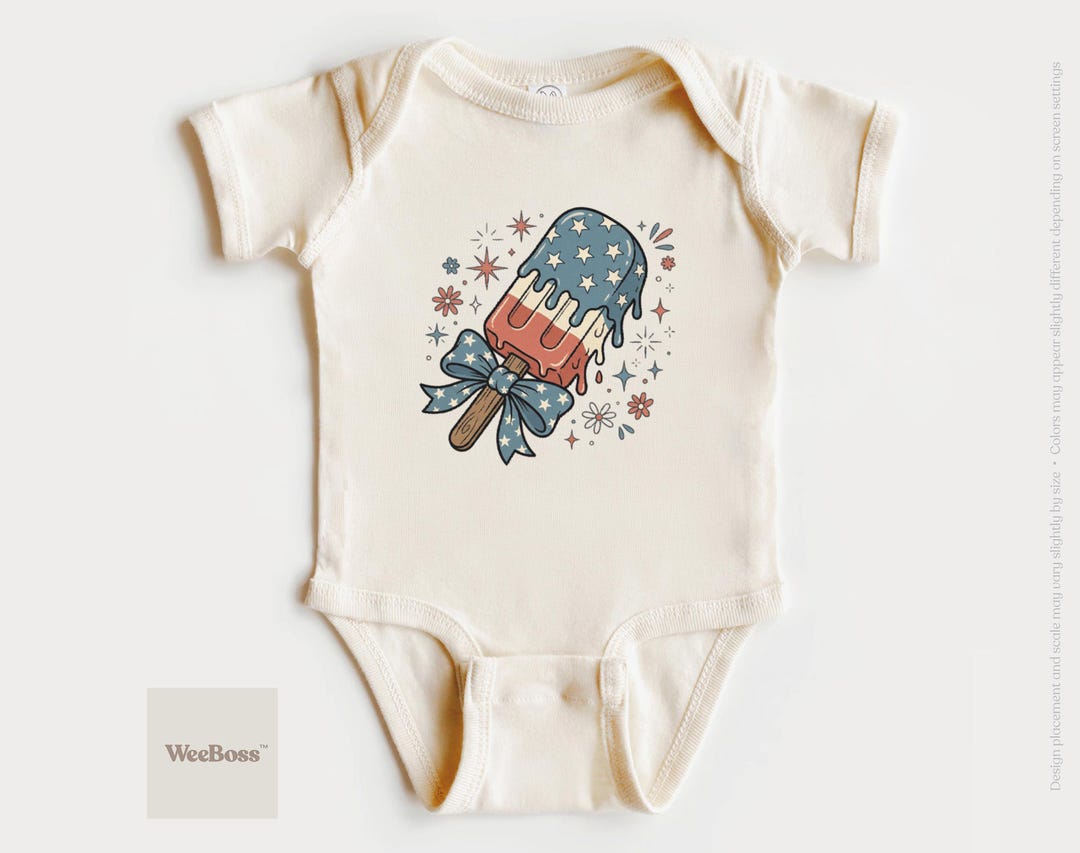
Patriotic Popsicle
A starry ice cream design that reads as summer first and patriotic second. Works for the 4th of July. Works for the rest of the summer. Natural cotton, soft palette, no flag required.
View on Etsy →
For families who want the patriotic angle without the costume register, funny baby clothes: what feels clever and what feels tacky covers the adjacent question of when humor and festivity land well and when they do not.
More on Baby Summer Style and Practical Clothing Choices.
- Funny Baby Clothes: What Feels Clever and What Feels Tacky — the same line between a good graphic and a novelty prop, applied to humor
- Matching Family Outfits That Don’t Look Cheesy — coordination logic for the whole family at the 4th of July and beyond
- What Babies Wear in the First 3 Months — the fabric and fit basics that apply year-round, including summer
- Outdoorsy Baby Gifts — for families spending the holiday outside, where the clothing requirements are real
- Baby Bodysuit vs. Romper: Which Makes the Better Gift? — the garment decision before the graphic decision
- What Size Baby Clothes to Buy as a Gift — if this is a gift for an upcoming July 4th, the sizing logic applies
A Short Answer If You Are Still Deciding.
A 4th of July baby outfit that works:
- Is made of soft, natural cotton.
- Has one patriotic color reference, not three.
- Could be worn in mid-July without the holiday to justify it.
- Is comfortable for five hours of actual July weather.
- Photographs well in real outdoor light, not just product studio conditions.
- Does not come with an accessory the baby will remove immediately.
It does not work if:
- The graphic announces the date so specifically that the outfit has no life after it.
- The fabric is synthetic and the holiday is in July.
- The first read from across the lawn is “costume.”
- It only survived the photo because the baby was stationary.
The gap between a good 4th of July baby outfit and a bad one is rarely about the patriotism. It is about the design intent. One was designed for the day. The other was designed for the photo of the day. The photo usually turns out better when the outfit was designed for the day.